Trailblazer Guides are produced by people who know exactly what information is needed - not just to get from A to B but to be entertaining as well as informative.
— The Great Outdoors
Adventure Cycle-Touring Handbook
Excerpt:
Planning (sample section)
Contents | Introduction | Planning (sample section) | Sample route outline: Peru | Tales from the Saddle (sample) | Contributors
Planning and preparation
A PLAN
Before beginning to think about details and specifics, it is important to consider the wider aspect of your trip. Ask yourself what type of tour you want to take, where you want to go and what you hope to get out of it and from the ideas that flow from you and the information provided in this section, a plan will begin to take shape.
A major attraction of cycle-touring is the immense freedom and flexibility it affords you, so think about what inspired you to travel by bicycle and indulge in a bit of blue-sky thinking about dreams, destinations and goals. You may doubt you have it in you, but aim high – your abilities will surprise you and what was, or seemed, impossible before the trip will gradually become reality as you become a stronger, more confident tourer.
One of the aims of this book is to prepare you to ride in places most people would not even consider visiting – a sure way of providing a wealth of indelible memories – but those big ideas need to be tempered by realism. Independent biking in Tibet isn’t legally possible and the Morocco-Algeria border has been closed for years; that road across the Darien Gap still ain’t done, and do you really want your first experience of cycle-touring to be taking on the infamous wall of Patagonian wind? Good preparation will foresee and outmanoeuvre these problems, meaning you can spend more of your trip doing what you’re there for, whether it be riding, soaking up culture or socialising.
Having a plan doesn’t take the spontaneity out of things – you’ll still stop when you want, take on board travel advice gleaned from roadside conversations and change your route at regular intervals when that enticing track that catches your eye at a crossroads proves just too tempting to resist. But investing time in preparing a plan saves the inconvenience of cycling into dead ends from which it will take time and money to extricate yourself: stumbling upon a shut border post for example; or reaching a country where you needed to apply for a visa months in advance; or hitting passes in winter when they’re closed by snow.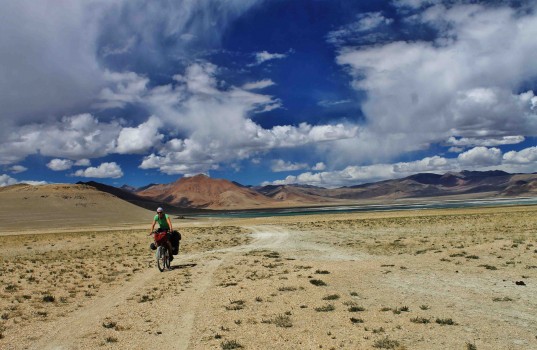
WHAT KIND OF RIDE?
There are different ways of touring on a bicycle. You could stick to tarmac, or hunt down unpaved roads; you could pile your panniers full of gear for every eventuality and comfort, or get by on the bare minimum; you could go on shorter, focussed trips or decide to set aside a few years of your life to cycle the globe.
If you haven’t toured before, by far the best way to start working out which suits you best is to go on a short practice tour or two – it’s a personal experience and only by being out on the road can you discover what you truly enjoy. Keep it simple, and to avoid shelling out on a new bike and gear right away try to use a bike you already own (or borrow from a friend) and go off for a few days or weeks. Head out on different surfaces and with different amounts of equipment to see which you prefer. For Brits, a route such as Land’s End to John O’Groats is a perfect introduction and a good way to ascertain whether you even like the touring lifestyle. Not everybody does and it’s better to find out in the vicinity of Chester rather than Chengdu.
Tarmac or unpaved?
Nowadays it’s almost possible to cycle the length of every continent without leaving tarmac; conversely if you search hard and plan well you can avoid the blacktop and wend your way across landmasses on dirt and gravel roads. All adventure cycle-tourists mix and match the two, albeit to varying degrees, so you’ll want to tailor your bike and how much gear you carry to the surface on which you will be spending most of your time. Almost everything is possible on a bike (see box p294), so you can tackle unpaved roads on road-orientated touring bikes and tarmac on knobbly tyres; it just happens to be faster and a lot more enjoyable, rideable and comfortable if you have the right steed for the terrain you expect to concentrate on.
Level of comfort
You need to decide on the level of comfort that is right for you and this in turn will help determine how much kit you carry. Do you want to travel with a spacious tent, multiple pans to prepare gastronomic delights when you’re camping in the middle of Mali, and carry changes of clothing to stroll around town in on your day off? Or will you be happy in a 1kg tarp-tent, cooking and eating out of the same one pan with just a change of t-shirt for rest days? There are more details on p75, and some riders’ thoughts and explanations for what’s packed in their bags.
Length of trip
A ride of a month is a very different undertaking from a year-long tour across a continent, so having an idea of how long you wish to be (or can be) away will help you decide not only where to head and what’s achievable but also how much equipment to take and how hard wearing it needs to be. There are no right or wrong answers to any of these issues. Pick what appeals to you most as you’ll have an adventure whatever you do, but they’re all factors to consider before starting to look for new kit.
WHICH CONTINENT?
You may always have dreamed of visiting a certain place – to hear that crunch of tyre on Bolivian salt-flat or experience the thrill of pedalling past Zanskari gompas and glaciers. Perhaps your aim is to cross continents from Cairo to Cape Town or Alaska to Ushuaia? If this is the case your first decision will already have been made and you can home in on the particular section of the Route Outlines to delve deeper into those destinations. But for those who’ve made up their mind to embark on a bike trip but haven’t settled on a destination, here are some classic trans-continental rides to whet your appetite.
From the UK and Europe, it’s possible to wheel out of your front door, point east, and cycle to China or South-East Asia. The most popular route slices through Turkey, Iran, and Central Asia, with detours via Siberia and Mongolia possible. Routes through Asia (see p127) offer a wealth of fascinating cultures and history, and astounding scenery; visa issues and avoiding the paralyzing winter cold and lassitude-inducing summer temperatures will be your biggest logistical challenges.
Cycling the length of Africa (p229) is the least common of the trans-continental rides. Despite the attractions of wide open spaces, wild animals, and friendly locals, it can be a draining continent to traverse; but from challenges, the strongest and fondest memories are often forged. Cairo to Cape Town is by far the most popular north-south route, though taking an exciting ride down West Africa is another option. The heat of a Saharan summer is the main season to side-step.
The Americas (p255) draw an increasing number of adventure cycle-tourers, lured by the lack of bureaucracy, the convenience of needing to add only Spanish to their repertoire in order to be able to communicate with everyone en route, and the magical scenery that rarely abates as you migrate with the seasons along the longest continental landmass on earth.
SEASONS AND CLIMATE
A bike tour involves being outside most of the day, most days; this is one of its great joys. It also means that weather will play a far more significant role on your existence and morale than it does in a sheltered, indoor lifestyle back home. Most people agree hauling your bike up Sikkim’s steep gradients in monsoon season is silly – your clothes will grow mould and Kangchenjunga will remain swathed in cloud for the entirety. And who likes cycling in the rain anyway?
Despite increasing weather instability across the globe, ensure your plan takes into account the climate at the time you’ll be visiting as this can be key to enjoyment. British riders in particular should be aware that the weather in many parts is nowhere near as benign as back home. Just as important in relation to climate is the fact that many of the world’s most beautiful roads are seasonal: snow, mud, impassable landslides or water keep them off-limits to cyclists at the wrong times of year, so even being hardy enough to stick out the elements doesn’t guarantee you’ll be able to cycle that longed-for route.
Factoring favourable seasons into a ride is essential, so devour the Route outlines section for information, whilst noting that for a longer ride it’s simply not feasible to always be in the right place at the right time. Reading up will enlighten you about some of those climates that regularly catch cyclists out. For example don’t make the mistake of thinking Turkey is all beach resort – Speedos and towel won’t keep you warm in a winter blizzard in Kurdistan when it’s -20°C and the next tea house is still 50km away.
Which direction?
For trans-continental rides, the question of which is the best direction to travel is usually most pertinent in the context of getting your seasons right. For shorter, more-focussed tours however, never ever underestimate prevailing winds. The simple decision of choosing which way to go can make or break a ride, as cycling into a head wind day after day can be soul destroying. To glance at a Patagonian tree, hear a monologue of half-crazed nonsense vomited by a lone-wolf two weeks into a northward ride from Ushuaia, or survey the sand-blasting damage on a kilometre marker in the Puna de Atacama (see below) will make it blindingly obvious which way you’ll want to be tackling a route. And the Andes by no means have a monopoly on the world’s winds – Mongolia, Western Sahara, Iceland, they’re all breezy too, so if you’re concentrating on one region, factor that into your planning.
It is sometimes easier logistically with visas or border crossings to head in a particular direction so take note when these are mentioned in the Route Outlines.
BUDGET AND TIME
The cost of kitting out a tour and daily expenses on the road, as well as the length of time taken to pedal across continents, varies significantly between riders as we all have different styles.
Touring can certainly be done on a shoestring but if you have the resources then investing in strong, durable, tried and tested gear is a sensible policy. With confidence in the reliability of your bike you can forget worrying about it breaking down and you’ll save time and money on the road if the need for repairs is kept to a minimum.
Most tourers from the UK spend at least £700 on a bike, racks and panniers for a long trip; £1500 gets you a new expedition bike with strong racks and panniers that have been purpose-built for a tough transcontinental tour. If you don’t already own it, good quality camping kit and hard-wearing outdoor clothing that’ll survive a year or more of touring will cost upwards of about £800.
The sky’s the limit in terms of what it’s possible to spend on biking and outdoor equipment. If you’re on a tight budget, don’t lose sight of the fact your last £500 is much better invested in a few months on the road than on titanium handlebars or a jacket that was designed with the West Face of K2 in mind.
On the road
On the road, bicycle touring is arguably the cheapest form of long range travel. Having amassed all necessary gear and made it to the start of your ride, you can live frugally, if desired, as many of the major costs of backpacking and other ways of travelling simply do not apply.
Except when you choose to throw your bike on a vehicle, take a flight, or need to fix a worn-out or broken bike-part, you’ll be spending no money day to day on transport. Though you’ll stay in hotels and guesthouses, many nights are spent wild camping and if you’re lucky there’ll be times where you are hosted as someone’s guest, saving on accommodation, which would normally be the biggest expense of the day.
Food will be a major expense; enormous amounts of fuel disappear down cyclists’ gullets at each and every pit-stop, but as you’ll find yourself off the beaten track, stocking up on local food at small shops and eating at cheap restaurants in non-touristy places, you’ll discover that food prices in most of the world are lower than at home.
Insurance and any visas complete the last of the major categories of expenditure on a bicycle tour. The latter is dependent on where you choose to head; there are no visa fees for EU nationals in the Americas, whereas in Asia and Africa getting hold of those little stickers and blurred stamps in your passport adds significantly to total costs.
Bear in mind that while it’s possible to do a trip incredibly cheaply, and you’ll come across the odd rider boasting of having survived for years on US$2 a day, do you really want to penny-pinch this much? It’s nice to splash out on a decent meal and a bed every now and then after a tiring period out on the road.
Adventure Cycle-Touring Handbook
Excerpts:
- Contents
- Introduction
- Planning (sample section)
- Sample route outline: Peru
- Tales from the Saddle (sample)
- Contributors
Price: £15.99 buy online now…
Latest tweets