Worth watching out for.
— John Cleare
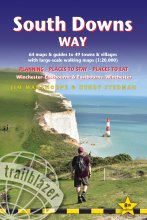
South Downs Way
Excerpt:
Practical information for the walker
Contents list | Introduction | About the South Downs Way | Practical information for the walker | Itineraries | Using this guide | Sample route guide and maps: Exton to Buriton | Stage map and profile: Winchester to Exton
Practical information for the walker
Route finding
There is very little opportunity to get lost along the Way. It would be an easy route to follow even without the waymark posts, which are usually marked with the National Trail ‘acorn’ symbol. An acorn on a yellow chevron indicates that this route is a footpath, ie exclusively for pedestrians. A blue background indicates that the trail is a bridleway and can therefore also be used by horses and cyclists. A purple background quaintly adds a pony and trap. A red or white background warns that the route can also be used by motorbikes. Bear in mind that other footpaths may be indicated on the waymark posts so follow the acorn.
Nevertheless, it is hard to go astray. Should you find yourself erring from the path the chances are a fence on one side or the steep Downs escarpment on the other will deflect you back in the right direction. In addition there are usually other walkers around who you can ask for directions.
Using GPS with this book
Given the above, modern Wainwrights may scoff while more open-minded walkers will accept that GPS technology can be an inexpensive, well-established if non-essential navigational aid. In no time at all a GPS receiver with a clear view of the sky will establish your position and altitude in a variety of formats, including the British OS grid system, to within a few metres.
The maps in the route guide include numbered waypoints; these correlate to the list on pp182-5, which gives the latitude/longitude position in a decimal minute format as well as a description. Where the path is vague, or there are several options, you will find more waypoints. You can download the complete list of these waypoints for free as a GPS-readable file (that doesn’t include the text descriptions) from the Trailblazer website: : www.trailblazer-guides.com (click on GPS waypoints).
It’s also possible to buy state-of-the-art digital mapping to import into your GPS unit, assuming that you have sufficient memory capacity, but it’s not the most reliable way of navigating and the small screen on your pocket-sized unit will invariably fail to put places into context or give you the ‘big picture’.
Bear in mind that the vast majority of people who walk the Way do so perfectly well without a GPS unit. Instead of rushing out to invest in one, consider putting the money towards good-quality waterproofs or footwear instead.
ACCOMMODATION
The South Downs lie in a populous area so there are plenty of villages and towns within easy reach of the Way, most of which offer accommodation for the walker. However, the Way generally follows the high ground along the top of the South Downs escarpment while the villages lie at the foot of the hills. This tends to leave the walker with a small detour to reach a bed at the end of each day. Bear this in mind when calculating times and distances from the maps in Part 4. As a general rule it is a good idea to allow an extra hour each day for the walk to and from your accommodation.
Camping
Unfortunately, there is little to no opportunity for wild camping on the South Downs so campers will have to rely on organised campsites of which there are few. Refer to the itinerary chart for campers on p32 to organise a schedule. Most of these campsites charge from £5 per camper. Some of the more complex, organised sites have showers and washing facilities while others are merely a place to pitch a tent in the grass.
It is difficult to arrange a camping trip along the length of the Downs without being forced into more solid accommodation for one or two nights. Those who have the urge to camp in greater isolation where there is no recognised site may find it worthwhile asking a landowner for permission to set up camp.
Those who do camp will certainly appreciate the experience: the pampered comforts of a bed and breakfast are outweighed by the chance to sleep under the stars and be woken by the sun, should it happen to be showing.
Hostels and camping barns
There are five youth hostels within easy reach of the Way but all are between Arundel and Eastbourne.
Despite the name, anyone of any age can join the YHA. This can be done at any hostel or by contacting the Youth Hostels Association of England and Wales (YHA; % 0800-0191 700 or % 01629-592700, : www.yha.org.uk). The cost of a year’s membership is currently £15.95 (£9.95 for anyone under 26). Having secured your membership, YHA hostels are easy to book, either online or by phone. The hostels also offer a booking service and will reserve a bed at the next stop on the path for you.
Each hostel has a drying room, shower and a fully equipped kitchen. Telscombe (see p154) is self-catering only but has a small shop. The others offer breakfast, a packed lunch and an evening meal. Arundel and Alfriston have wi-fi.
There’s an independent hostel located near East Meon called Wetherdown Hostel (p92) and a camping barn run by the National Trust near Bignor Hill, which goes by the charming name of Gumber Bothy (p114).
Bed and breakfast
Some B&Bs can be quite luxurious and come at a price but in our experience all the Downs walker really wants is a warm bed and a hot bath. For this reason most of the B&Bs listed in this guide are recommended because of their usefulness to the walker and convenience to the Way, not for how many stars the tourist board has awarded them.
Bed and breakfast owners are often proud to boast that all rooms are en suite. This enthusiasm for private facilities has led proprietors to squeeze a cramped shower and loo cubicle into the last spare corner of the bedroom. Not having an en suite room is sometimes preferable as you may get sole use of a bathroom across the corridor and a hot bath is just what you need after a day’s walking – and you will also probably save a few pounds.
You may find it hard to find establishments with single rooms. Twin rooms and double rooms are often confused but a twin room usually comprises two single beds which can either be pushed together for a couple or kept separate. A double room has one double bed. Family rooms are for three or more people and usually consist of a double bed and a single or three single beds.
Most B&Bs do of course provide a hefty cooked breakfast as part of the rate though some now also offer a lighter continental-style breakfast. Some also provide a packed lunch or an evening meal but you will need to give them advance warning and there will be an extra charge. Most B&Bs, however, are close enough to a pub or restaurant but if not the owner may give you a lift to and from the nearest eating place.
Rates B&Bs in this guide vary from around £40 for two sharing a room and for the most basic accommodation to over £70 for the most luxurious, en suite places. Most charge around £50 per room. Remember that many places do not have single rooms and deduct between £5 and £15 for single occupancy of a double or twin room. Prices can be less during the winter months and if you are on a budget you could always ask to go without breakfast which will usually result in a lower price.
Guesthouses, hotels, pubs and inns
Guesthouses are usually more sophisticated than bed and breakfasts, offering evening meals and a lounge for guests; rates are around £30-40 per person.
Pubs and inns offer bed and breakfast of a medium to high standard and have the added advantage, of course, of having a bar downstairs, so it’s not far to stagger back to bed. However, the noise from tipsy punters below your room might prove a nuisance if you want an early night. Prices usually range from £30 to £40 per person per night.
Hotels are usually aimed more at the motoring tourist rather than the muddy walker and the price (£40-60 per person) is likely to put off the budget traveller. A few hotels have been included in the trail guide for those feeling they deserve at least one night of luxury during their trip.
.
South Downs Way
Excerpts:
- Contents list
- Introduction
- About the South Downs Way
- Practical information for the walker
- Itineraries
- Using this guide
- Sample route guide and maps: Exton to Buriton
- Stage map and profile: Winchester to Exton
Price: £14.99 buy online now…
Latest tweets