Guides that will send you packing.
- Today
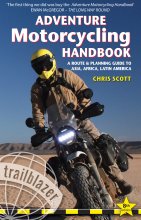
Adventure Motorcycling Handbook
Excerpt:
Tales from the Saddle (sample)
Contents list | Introduction | Planning and preparation | Choosing a motorcycle | Life on the road | Sample route outline (USA) | Tales from the Saddle (sample)

Since his first XT500 trip back in ‘82, none of Chris Scott’s Saharan rides have gone to plan so why should the Desert Riders Project be any different?
The three of us reigned in our motorcycles, cut the engines and stared ahead. Around us the horizon was a flat 360° sweep – sky above and the sands of Niger’s Ténéré Desert below. But those three silhouettes on the horizon – were they a trio of army or smuggler Land Cruisers, neither of which we particularly wanted to meet, or the desolate sandy mounds of the Lost Tree which we’d set course for yesterday? I zoomed in the camcorder but was none the wiser. Whatever, they’d have spotted us by now.
A couple of weeks earlier we’d taken a ferry to Tunis and crossed into Algeria a day or two later. We rode south through the oilfields and through the dunes of the Grand Erg Oriental sand sea, where we fitted fresh knobbly tyres and buried our road tyres for the ride back. The adventure was upon us.
Our plan was to explore challenging new routes in the central Sahara, a place I’d ridden for over 20 years. To help extend our range, three months earlier I’d driven out in my Toyota to bury fuel, water and food at three key locations in southern Algeria. The main cache at Erg Killian in the far south would enable us to make the 2000km round-trip to the Lost Tree in Niger. With no tracks, let alone wells, this sort of riding was extreme, even by Saharan standards.
With our Michelin knobblies primed and just enough fuel to get us to the first dump, we hit the sands on what we’d come to dub ‘the Red Sheds’. It soon transpired that our out-of-the-crate Honda XRLs imported from Australia were a long way short of the more purposeful KTM Adventures we’d also considered, but after six months’ tinkering they were as good as they could be.
The first part of the route led us into a sea of dunes, a route I’d blundered through before, but never the same way twice. With tyres sagging, our throttles were pinned as we ploughed our way into the Erg. Soon Andy’s oil temperature gauge was reading 145°C, but on the dunes we had to keep moving or sink into the sands. After a few dead-ends and a well-timed ‘emergency eject’ right on the crest of a big drop-off, I located the old French colonial straw-bale ‘road’ which led out of the dunes into the valley and to a well for the night. The worst of the dunes were behind us and though on the limit, the 650s had pulled us through. But we knew there were more challenges ahead.
Next morning we passed the ruins of the old Legionnaires’ fort at Ain El Hadadj, crossed another small dune barrier with some difficulty and with the GPS, located a pair of jerricans and some baked beans I’d left in a tree. From here we would leave the regular route and head south into the unknown. Our plan was to locate and follow the Oued Samene canyon 100km to its watershed on a huge escarpment, and hopefully ride down the far side to pick up the trans-plateau highway. It was ambitious in the extreme and though I’d studied maps and sat images for months, I still had no idea what to expect; no one I knew had ever travelled here.
We rode in a corridor between a ridge of huge dunes and the cliffs of the Tassili plateau with no tracks but our own. Most routes in the Sahara follow pistes (French for ‘tracks’), which are generally easy, safe and sometimes even marked with posts. Cross-country or off-piste riding is another thing altogether. Here you ride not with maps or GPS, but where the terrain allows, and you’re entirely on your own.
Being off-piste gave an edge to the experience that was exhilarating and liberating – picking our way over small scarps and huge dunes, vegetated creeks and rocky hills. The riding was perfect and by the evening we estimated we were within a few kilometres of the canyon rim.
Next morning that all changed; after an a hour of pushing, pulling and paddling we’d covered just one kilometre. A rock-strewn hillside lay between us and the GPS point we were aiming for on the canyon rim. We decided to ditch the bikes and recce on foot.
By late morning the cliff-rimmed canyon spread out 100m below us, clearly unrideable – but downstream a vast sandbank spilled down from the rim right to the canyon floor, providing a one-way slide into the canyon. It took the rest of the morning to push and ride the bikes to the top of the unrideably steep slope, and as long again to walk them down to the canyon floor. Here we called in a SatChat for the website and then wearily struggled up the riverbed, dodging boulders and trees, and spinning in the powdery creek sand. When we came across an abandoned encampment of grass huts we threw off our sweaty riding gear and exhausted, turned our backs on the cumbersome Sheds.
We’d bitten off more than we could chew with Oued Samene: our top-heavy, over-wide machines were a liability long before a rider got too tired to ride. Next morning we dropped our gearing and turned back along the riverbed out to the mouth and back north for 300km to Illizi town.
Showered and fed, bowed but not beaten, we had another new route lined up to cross the plateau close to the Libyan border. Sure enough it proved to be a classic mountain route – clear tracks most of the way following the base of the same 500-km long escarpment we’d planned to breach from Oued Samene. Towards evening Andy’s pannier clipped a rock and sent him flying to land with a crunch, so we camped early in a shallow creek bed. By next morning he’d bounced back and we pursued the fabulous ride across the plateau.
You’d think we’d know better, being Desert Riders, but we’d run out of water. A hoped-for well did not materialise so we pressed on south on the promise of a waterhole 80km away. It took three hours of the roughest riding yet, a tyre-shredding, spoke-bending track with hairy ‘one chance’ launches out of rocky creek beds. We reached the waterhole at sundown, beaten to a pulp, and crashed out pretty much where we dropped.
By next afternoon we were sipping milky coffees in the lovely oasis of Djanet in Algeria’s southeast corner, with steak-frites piled up in front of us. Our plan had been to get Niger visas in Tamanrasset or ‘Tam’ but that now involved a 1500km roundtrip that we just could not face. I was also in two minds about our planned route southeast into Niger: the last time I’d been here two Austrian parties heading for Cape Town had taken that route and been brutally robbed a day or two later.
Still, we had 120 litres of fuel, water and a Christmas hamper of food waiting for us way off the main piste at Erg Killian where there was little chance of meeting so much as a fly. Plan B was conceived: head cross-country for the stash, slip into Niger for a quick visit to the Lost Tree and nip back into Algeria before we got nailed.
We filled every last fuel container and headed with trepidation out of town and into the Erg Admer sand sea. I knew the way through but also knew that the final barrier dune would be a struggle for the tanked-up Hondas. But when the time came we hit the slope hard, sailed to the top, down the other side and on to the gravel plain below. Hereabouts longitude E8° 45’ looked like a promising corridor on the map so we set our GPSs for the fuel dump, turned south and hoped for the best.
Initially the going was rough and slow but once we crossed the ancient floodplain of the Oued Tafassasset the desert finally opened out. Compared to the rock-bashing on the plateau the previous week, the riding here was serene: the typical Saharan pattern of dazzling sand plains and a distant rocky ridge which you eventually reach and cross to gaze across another shimmering sand plain.
No one was more surprised than me when we reached the fuel dump by 4pm – and we weren’t even knackered! Sandstorms had blown through in the intervening months of course, but I recognised the rock-marker in the dunes where the handle of a jerrican poked out. A bit of digging revealed the water and, Hey Presto: a drum of food! We dragged it all back to the camp and by dusk lay bloated in the sands, blissed-out on an overdose of our favourite foods.
Today was the Big Day, hopefully a 300km run over the border to the Tree. The bikes were stripped of non-essential baggage and by mid-morning we were probably on the Algeria–Niger border. Our now empty fuel drums were fashioned into the historic ‘DRP 2003’ monument. We sang the hearty ‘Desert Riders Song’ and then keyed our Garmins to the Tree: bearing 134°, distance 242km. The legendary sands of the Ténéré were upon us.
You can’t beat the thrill of riding on untouched terrain. The nearest piste was miles away and even then, was rarely used. But smugglers and bandits were travelling on our wavelength, as were the Algerian gunships which hunted them. We sincerely hoped to avoid both, which explains why we ‘miraged’ the unwanted Cruisers when, after a freezing overnight bivouac, we finally approached the Lost Tree.
We rode on warily but relaxed as the withered remains of the centuries-old tamarisk tree came into view, a lone living landmark in 100,000 square miles of barren desert – just a fraction of the Sahara’s extent of course. In the bitter cold we hurriedly paid our respects to Thierry Sabine, the Paris–Dakar Rally founder whose ashes were scattered here in 1985 after his chopper crashed in a sandstorm near Timbuktu. That done, we belted back to Algeria before we got in trouble.
What a ride that was! In the Oued Samene we DNF’d after just 4km; today we covered 400 and by the end nothing could stop the fuel-lightened 650s skimming over the sands back to the stash at Erg Killian. We ended the day buzzing after our adventure; job done.
But our good fortune was about to change. Heading back north I got a puncture and Andy ended the day with a series of flats that finished off his rear tyre. We repaired it as best we could on a sandy plain dotted with Neolithic tools dating back to a time when the Sahara was a grassy savannah. To the west lay the peaks of the Hoggar: no place for a split tyre and a patched-up tube. The plateau highway was only 100km away so Andy decided to call it a day; there was no chance of getting spares in Algeria so he’d struggle home as best he could (and a struggle it indeed turned out to be!).
Jon and I rode west along the tourist route I knew well, over dreary corrugations and bulldust. Out of water and food again, we hit Tam for some rest and repairs. It was the festival of Tabaski, the end of the Ramadan fast, and the campsite owner slaughtered a goat as four other bikers rocked up on a KTM, Paralever and an Africa Twin, including Dutchman Arjen who I’d met the year before. They were planning to take the Erg Killian route too, but with a guide in a pick-up to carry the extra fuel.
Jon and I said goodbye to the three guys next morning and headed up to the fabulous Assekrem Pass, one of the Sahara’s highlights, especially at dawn, when the sun rises over the primeval panorama of volcanic cones. Riding down the rarely used far side of the Hoggar was rough; the pannier-bashing track really took it out of us and by nightfall we were back to that staggering, backachey worn-out feeling we knew so well.
Joining the sealed Trans Sahara highway for a bit, we filled the water bags and headed north to Garet El Djenoun or ‘Mountain of Spirits’, a striking granite peak which I’d passed many times and thought might be climbable. By the end of the next day Garet was in our sights, as were another 110 litres of fuel stashed among some rocks to the north, below the Tassili plateau …
The next thing I know, I’m lying on the ground with my helmet under my head. How did I get here? Ouch! it hurts to breathe. Over there Jon is kicking my bike straight. He comes over and points my Sony in my face…
After all the near-misses crossing sandy creeks, rocky plateaux and dunes, I’d flipped out on a virtual runway, landed badly and bust some ribs. Jon dragged me off the piste and a day later the sat phone got through to a German guy in a Unimog who took me back to Tam, gritting my teeth over every jarring bump. A couple of days after that, hobbling and breathing were less painful and we set about flying the bikes back to the UK.
Garet, the fuel stash and even Oued Samene would have to wait, for the party was about to end in Algeria.
A week after I got back Arjen and his mates were among 32 tourists abducted by terrorists near Oued Samene. Had I not crashed out it’s likely Jon and I would have ridden straight into the multiple ambushes. Arjen’s group were held captive in desert hideaways for six months, during which time one woman died of heatstroke; the rest of the hostages were finally released for a officially-denied €5 million ransom.
It’s no longer possible to roam the wild Algerian borderlands. Now you need an expensive escort and can only drive on the highway. Our Project had unravelled, but what’s new! We’d seen the promised land and tasted the thrill of unsupported cross-country riding. Regular tracks would never be the same again.
Adventure Motorcycling Handbook
Excerpts:
- Contents list
- Introduction
- Planning and preparation
- Choosing a motorcycle
- Life on the road
- Sample route outline (USA)
- Tales from the Saddle (sample)
Price: £12.99 buy online now…